1 Corinthians 11:3
“But I would have you know, that the head of every man is Christ; and the head of the woman is the man; and the head of Christ is God.” (KJV)
Many of the errors that arise in theology originate from misinterpretation and a lack of context. Context in scripture is paramount, second only to Jesus as Savior. Regarding this specific issue, the theological debate surrounding male headship frequently obscures the fundamental elements of the creation order as the primary key. That said, there is a cascading effect that Paul is referring to; however, to accurately understand the context, we must start with Paul’s background and build from that foundation.
The context ought to consistently adhere to these principles. When we learn to incorporate them into our reading, studying, and daily worship, they significantly influence our attentiveness and reflections, guiding us more profoundly into scripture while bringing glory to God. These principles as presented here are not intended to be exhaustive; rather, they serve an instructive purpose.
General Principles
- First, the immediate context.
This is indispensable and non-negotiable. The verse must be read within its sentence, paragraph, and argument flow. - Second, the epistolary or book context.
The argument of the whole letter (or book) governs how any part functions. - Third, the authorial (corpus) context.
Scripture interprets Scripture within the same human author. - Fourth, the canonical (redemptive-historical) context.
The passage must be located within the whole canon—Creation, Fall, Redemption, New Creation. - Fifth, the theological (God-centered) context.
All exegesis terminates in God Himself—His being, attributes, and works revealed in Christ.
“For from him and through him and to him are all things. To him be glory forever. Amen.” (Romans 11:36, ESV)
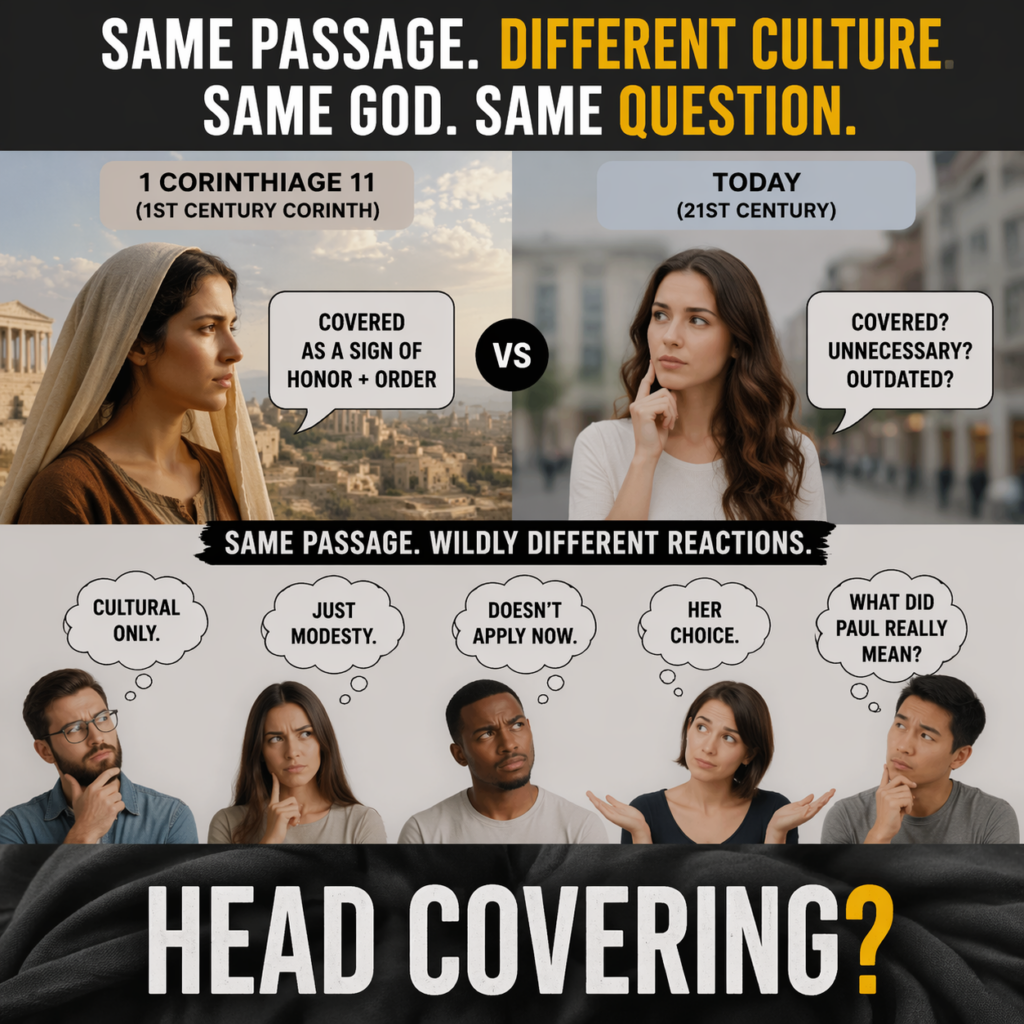
Paul’s instruction in 1 Corinthians 14:33–35 must be read first within its immediate context, where he regulates corporate worship (1 Cor 14:26–40), establishing that all speech—tongues, prophecy, and participation—is to be governed by the principle that “God is not a God of confusion but of peace” (ESV). This statement serves as the theological ground for his command, showing that the issue is not mere custom but the ordered nature of God reflected in the gathered church.
Within the epistle, this section concludes a larger argument (1 Cor 12–14) concerning the edification of the body through rightly ordered gifts, so that “all things should be done decently and in order” (14:40). In broader Pauline context, this concern for order and role distinction is not isolated: in 1 Timothy 2:11–14, Paul roots similar instructions in creation (“Adam was formed first”), while in Ephesians 5:22–25 he frames them Christologically, grounding relational order in the union of Christ and His church.
Thus, across his letters, Paul consistently integrates creation, redemption, and ecclesial life. The audience in Corinth, marked by disorder and confusion in worship, required corrective instruction addressing cultural disruption, ecclesial polity, and spiritual edification, whereas Ephesus required stable pastoral governance and doctrinal clarity. Canonically, Paul’s teaching stands within the unfolding of redemptive history: the ordered complementarity of Genesis 2:18–24, distorted in the fall (Genesis 3), is not abolished but restored and rightly expressed in Christ (cf. Galatians 3:28, which affirms equality of salvation without erasing created distinctions).
Therefore, interpreting this passage by Sola Scriptura requires that the immediate context governs its meaning, the Pauline corpus confirms its coherence, and the whole canon situates it within God’s unified revelation, so that the church’s practice reflects the peace, order, and holiness of God Himself.
I. Covenantal Context
The interpretation of 1 Corinthians 11 must be understood in the context of the author’s identity and the circumstances surrounding its composition, which serve to moderate the full extent of its expression. Paul is not acting as a cultural theorist; he speaks as an individual apprehended by Christ and commissioned with divine authority.
As it is written, “And last of all he was seen of me also, as of one born out of due time” (1 Cor. 15:8). His apostleship is not a matter of inheritance but is conferred: “Paul, an apostle, (not of men, neither by man, but by Jesus Christ)” (Gal. 1:1).
On the road to Damascus, the persecutor is brought into submission under the headship of Christ (Acts 9:3–6). This moment is not merely conversion but reordering. The one who sought to destroy the church is placed under its Head and commissioned to build it. Thus, when Paul later speaks of headship, he speaks as one who has been personally brought into its reality. His doctrine is based on personal biography transformed into theology.
II. Covenantal Steward of the Mysteries
Paul’s ministry is defined by stewardship: “Let a man so account of us, as of the ministers of Christ, and stewards of the mysteries of God” (1 Cor. 4:1). He does not invent doctrine; he delivers what has been entrusted. Corinth, the immediate context of 1 Corinthians 11, is a city marked by disorder—social, moral, and religious. Into this environment, Paul brings about gospel alignment. “For I have received of the Lord that which also I delivered unto you” (1 Cor. 11:23). His authority is derivative contextually, historically, and
expressed as revelation (God’s self-disclosure). Paul is under Christ’s headship even as he exercises apostolic authority within the church. This mirrors the very structure he teaches; ordered relation under the headship of Christ, with God above us all.
III. Covenantal Imitation and Embodiment
Paul commences the pertinent section with a compelling directive: “Be ye followers of me, even as I also am of Christ” (1 Cor. 11:1). The concept of headship is not an abstraction; it is a lived reality, precisely because it constitutes a living, organic entity, applying to both men and women as exemplified in John 17, Romans 12, and Galatians 5-6.
Christ is the head of Paul. In faithful imitation, Paul becomes a model for the church. The church, in turn, follows by perceiving Christ reflected in apostolic life. This creates a cascading historical pattern of covenantal representation. Authority is never autonomous; it is always representative, reflective (learned), and accountable. Paul’s life, characterized by suffering, sacrifice, and obedience (2 Cor. 11:23–28), demonstrates how authentic headship bestows, even and especially within the established Covenant order. Consequently, when he instructs men and women in worship, he is not imposing external order but beckoning them into the very pattern he himself exemplifies, following Christ as the highest form of covenantal living.
IV. Covenantal Order in the Assembly
The Corinthian church exemplifies the tensions pertinent to its cultural context. Issues such as the confusion of roles, the misuse of freedom, and disorder in worship are addressed directly by Paul, not by appealing to individual preferences or cultural norms but through the lens of covenantal history within creation as established by Christ.
“Every man praying or prophesying, having his head covered, dishonoureth his head… every woman that prayeth or prophesieth with her head uncovered dishonoureth her head”
(1 Cor. 11:4–5).
Paul’s primary concern is not control but clarity; worship must serve as a faithful testimony to the truth. The gathered assembly functions as a visible proclamation of God’s order before both the church and the heavenly host: “because of the angels” (1 Cor. 11:10).
His pastoral concern is evident; he does not merely seek behavioral correction but aims to restore alignment with divine reality. He also addresses this theme elsewhere, emphasizing the angels’ interest in and observation of the church, stating, “that through the church the manifold wisdom of God might now be made known to the rulers and authorities in the heavenly places.” (Eph 3:10)
V. Covenantal Continuity in Revelation
Paul consistently grounds his teachings from the outset. “For the man is not of the woman; but the woman of the man” (1 Cor. 11:8). This reference to Genesis in Paul’s theology demonstrates how creation is never forsaken; rather, all of revelation is established to instruct us from the beginning. Redemption restores and fulfills the original promises and hopes associated with creation. The same order established in Eden is now clarified and must be upheld within every historical iteration of the church.
Covenant is not incidental; it is fundamental. The present reality upon which we, as the Bride, must attend, serve, and support one another, thereby setting an example for our neighbors (the world). Therefore, Paul’s life and doctrine operate harmoniously. The one called by Christ proclaims a gospel that does not negate creation but redeems it into proper worship, exemplified by the conduct expected of the Corinthian Church.
VI. Covenantal Headship Perfected
Paul’s paramount concern remains Christ. “For I determined not to know any thing among you, save Jesus Christ, and him crucified” (1 Cor. 2:2). Headship, therefore, is not a social construct but a Christological reality. “For the husband is the head of the wife, even as Christ is the head of the church” (Eph. 5:23). In his personal life, Paul exemplifies this submission: “I am crucified with Christ: nevertheless I live; yet not I, but Christ liveth in me” (Gal. 2:20). The structure he advocates emanates from the life he leads. Christ’s headship over Paul serves as the model for all orderly relationships within the church, founded on the blood of the everlasting covenant.
VII. Covenantal Unity Without Confusion
Paul advocates caution against misinterpretation, cautioning that headship should not be exaggerated. As stated, “Nevertheless neither is the man without the woman, neither the woman without the man, in the Lord” (1 Cor. 11:11). The same apostle who affirms the importance of order also emphasizes unity: “There is neither male nor female: for ye are all one in Christ Jesus” (Gal. 3:28). These statements are not conflicting; rather, sin presents the contradiction. Unity is rooted in covenantal relationships; distinction is rooted in creation. Paul’s ministry emphasizes both principles without contradiction. His life among the churches—serving, laboring, correcting, encouraging—illustrates how truth should be both precise and pastoral. Today, we serve as prophets, priests, and kings, and our conduct should reflect these roles.
VIII. Covenantal Integration: Life, Doctrine, and Worship
Paul’s teaching in 1 Corinthians 11 stands within a unified covenantal framework.
- Creation establishes order.
- Paul is called into that order through Christ.
- His ministry proclaims and applies that order.
- The true church embodies it in worship.
- Christian families: Husbands, wives, and children embody it in life
Thus, doctrine, life, and practice converge. Paul does not merely teach headship; he lives under it, proclaims it, and orders the church according to it. This is demonstrated consistently in his inspired authorship. It is consistently taught in the letters to the Corinthians, Ephesians, and Galatians. Therefore, to properly understand 1 Corinthians 11 correctly, one must view Paul himself within an inspired, directed, and trans-generational (then and now) speaking context to the Church as the Bride. As a man brought under Christ’s headship, he teaches authoritatively to reflect that same divine order. His authority is submissive, his doctrine is received, and his life is patterned after the cross. Consequently, the passage is not an isolated regulation, but rather the manifestation of a life transformed by Christ and a ministry oriented toward the glory of God.
Head Covering in Covenant Clarity
The head covering in 1 Corinthians 11 serves as a visible emblem of an intangible, covenantal reality rooted in creation, structured through covenant, and fulfilled through Christ. Paul does not detach this practice from theological principles but instead associates it with the framework of God’s revealed order: “the head of every man is Christ; and the head of the woman is the man; and the head of Christ is God” (1 Cor. 11:3, KJV). This hierarchical structure is not a novelty in Corinth but was established at the inception—“God created man in his own image… male and female created he them” (Gen. 1:27)—and further supported by the statement, “the man is not of the woman; but the woman of the man” (1 Cor. 11:8; cf. Gen. 2:22–23).
Within this framework, the covering functions as a sign that accords with truth. “Every woman that prayeth or prophesieth with her head uncovered dishonoureth her head” (1 Cor. 11:5), because the visible act contradicts the invisible reality. Conversely, the ordered expression of worship reflects heaven’s witness, “for this cause ought the woman to have power on her head because of the angels” (1 Cor. 11:10), echoing that “unto the principalities and powers in heavenly places might be known by the church the manifold wisdom of God” (Eph. 3:10). Worship, therefore, is never merely horizontal; it is a proclamation before God and His created order.
However, Paul safeguards the doctrine against distortion by affirming covenantal unity: “Nevertheless neither is the man without the woman, neither the woman without the man, in the Lord” (1 Cor. 11:11), just as “ye are all one in Christ Jesus” (Gal. 3:28). Distinction does not imply division; rather, it enacts order. Headship does not diminish; it reflects Christ, “even as Christ is the head of the church… and he is the saviour of the body” (Eph. 5:23), who loved and gave Himself (Eph. 5:25).
Thus, the authority of Paul’s directive derives not from the physical covering itself, but from the truth it represents. “Judge in yourselves: is it proper that a woman pray unto God uncovered?” (1 Cor. 11:13). The church is entrusted with the responsibility to ensure that its visible act of worship aligns with God’s created and redeemed order. Whether through the traditional practice of wearing a covering or another clear and faithful expression, the fundamental requirement persists that the glory of God’s design is neither concealed nor denied.
Thus, the church publicly affirms what God has established from the inception, what Christ has accomplished through redemption, and what the Spirit now reveals through her (Bride) life and worship, “Let all things be done decently and in order” (1 Cor. 14:40).
“Submitting yourselves one to another in the fear of God.” (Eph. 5:21, KJV)
This verse establishes the covenantal posture of the church as a whole, men, women and children. All believers, united to Christ, live in a pattern of humility, service, and reverence before God. It is a Spirit wrought disposition flowing from being “filled with the Spirit” (Eph. 5:18), expressed in ordered relationships rather than cultural distinctions.Calvin treated this in the same way, referring not to the cultural practice but the constraining spiritual reality, and demonstrating the larger context found in 1 Cor 14, but then enters into conjecture, And hence a conjecture is drawn, with some appearance of probability.[1] Otherwise, his argument is very similar.
Additional Sources
With regard to these passages, Piper and Grudem’s “Recovering Biblical Manhood & Womanhood: A Response to Evangelical Feminism” devolves into probable arguments, attempting to cover the cultural distinctions between current Christianity and Islam.
One of the perplexing questions in this passage is this: What custom regarding adornment is referred to here? We cannot treat this complex question in detail, but the two most probable suggestions can be set forth: (1) The custom Paul recommends is for women to wear shawls. (2) Paul objects to long, loose hair that falls down the back; he wants women to follow the usual custom of piling their hair up on top of their heads.[2]
But their summary regards the then-present cultural aspects and Christ’s authority, from my main argument.
To sum up: the custom recommended here is a head covering of some kind, probably a shawl. The importance of identifying this custom can be exaggerated, unless one believes that the custom of the day should be applied to our culture. The major point of the text is clear: women are to adorn themselves in a certain way. The precise kind of head covering Paul had in mind is no longer clear. What is more important, and we turn to this next, is: Why does Paul want the women to adorn themselves in a certain way?[3]
Lenski articulates the same foundations; in his rigorous fashion, his commentary is very instructive.
Paul uses the same verb regarding both the man and the woman, ???????, “ought,” which expresses obligation and no more. He is not laying down an unalterable law that shall be in effect for the church of all ages and of all nations. While the facts of creation to which Paul goes back are in their very nature unalterable, they cannot be made an equally unalterable law regarding customs for the simple reason that customs vary endlessly for reasons that are not at all concerned with these facts. Only under certain circumstances an obligation may arise in which these facts play a part as was the case here at Corinth and among the Greeks. Established customs that beautifully symbolize these facts “ought” not to be changed arbitrarily but intelligently retained until, without prejudice to these facts, in due course, customs change of their own accord.[4]
Matthew Henry in his unabridged volume, says essentially the same thing, adding an important reflection upon the fuller context v 16 addresses,
VII. He sums up all by referring those who were contentious to the usages and customs of the churches, v. 16. Custom is in a great measure the rule of decency. And the common practice of the churches is what would have them govern themselves by. He does not silence the contentious by mere authority, but lets them know that they would appear to the world as very odd and singular in their humour if they would quarrel for a custom to which all the churches of Christ were at that time utter strangers, or against a custom in which they all concurred, and that upon the ground of natural decency. It was the common usage of the churches for women to appear in public assemblies, and join in public worship, veiled; and it was manifestly decent that they should do so. Those must be very contentious indeed who would quarrel with this, or lay it aside.[5]
I will conclude with a longer section from Kistemaker’s commentary; it is an excellent treatment of the overall discussion, and I highly recommend it.
In today’s culture, the presence of a hat does not signify subordination of a wife to her spouse. And Paul is not asking a woman to wear a headpiece or to put up her hair. Rather, he wants a woman to be distinctively feminine in respect to hair and dress and thus fulfill the role that God has intended since creation. He wants her to be submissive to her husband in her femininity. “The unique beauty of a woman is gloriously manifest in the distinctive femininity portrayed by her hair and her attendance to feminine customs.”
16. But if anyone is inclined to be contentious, we do not have such a custom, nor do the churches of God.
This is the conclusion to Paul’s discussion on women’s proper conduct. In a discourse on matters that affect personal predilection, a speaker or writer can expect to receive reaction from his audience or readers. Paul indicates as much with a conditional sentence that states a simple fact. Yes, there are people who wish to assert their individual rights. They probably use their slogan, “All things are permissible” (6:12; 10:23), and clamor for personal freedom. Even though Paul promotes Christian liberty, he teaches obedience to God’s ordinances and precepts. He desires that all things be done decently and in order.
a. “But if anyone is inclined to be contentious.” By using the term anyone, Paul speaks in generalities. He addresses neither the men, the women, nor a group of people. If anyone, even with good intentions, wants to argue about this matter, he will not receive a hearing from Paul. He has no time for someone whose mind is set on debating an issue for the sake of argument. The term that Paul has chosen to describe this person is “one who loves to argue.” This person could be either a woman who asserts herself with respect to accepted norms and wants to be free or a man who comes to her defense to debate Paul. We are not given any details in this summary statement.
b. “We do not have such a custom, nor do the churches of God.” Paul refuses to be challenged on his teachings that are based on the Old Testament Scriptures. He knows that the rest of the apostles support him, and therefore he confidently writes the personal pronoun we. This is not the so-called editorial we, but an inclusive pronoun that embraces other leaders in the churches.
What does the word custom connote in this setting? Calvin was of the opinion that Paul objected to the habit of arguing and disputing everything. Among Jewish and Gentile Christians, such conduct may have been evident especially in regard to matters of personal conduct. However, the passage itself conveys the sense that Paul has in mind the cultural practice of that day: that women wear head coverings during public worship services. He is saying that he, his fellow apostles, and the rest of the churches abide by the rule of being properly attired at worship. In brief, Paul appeals to the witness of the entire Christian church. Quite often in his writings he refers to all the churches. He brings the unity of the church to bear on the issue at hand. And he states implicitly that the contentious person, standing alone in this dispute, will have to face the whole church.[6]
Conclusion
From Calvin to more contemporary scholarship, the issue concerns the appropriate governance of authority, rather than a specific directive regarding head covering in the church generally. To interpret the scriptures in this manner (head covering required) constitutes a misapplication of the text. While it addresses the husband’s authority, it also pertains to the wife’s authority. This is why I consistently employ covenant imagery; it is explicitly articulated throughout scripture, offers a coherent Genesis to Revelation contextual framework for all of scripture, and is never overridden in any part of the text. It is a fascinating section of instruction, not limited to the few verses around head coverings, but as to how we honor God when we properly cover our wives, and encourage them to pray, share the gospel, sing the gospel and represent themselves not as autonomous ladies speaking dishonorably, but under the authority of the husband, who receives honor along with the wife, in glorifying Christ.
SDG
Matthew J Davis
[1] Calvin, John, and John Pringle. 2010. Commentaries on the Epistles of Paul the Apostle to the Corinthians. Vol. 1. Bellingham, WA: Logos Bible Software. (https://ref.ly/logosres/calcom67co1?ref=Bible.1Co11.5&off=1955&ctx=of+for+covering+it.+~And+hence+a+conjectu)
[2] Schreiner, Thomas R. 2006. “Head Coverings, Prophecies, and the Trinity: 1 Corinthians 11:2–16.” In Recovering Biblical Manhood & Womanhood: A Response to Evangelical Feminism, edited by John Piper and Wayne Grudem, 125. Wheaton, IL: Crossway.
[3]Ibid, 126–27. Recovering Biblical Manhood & Womanhood.
[4] Lenski, R. C. H. 1963. The Interpretation of St. Paul’s First and Second Epistle to the Corinthians. Minneapolis, MN: Augsburg Publishing House.
[5] Henry, Matthew. 1994. Matthew Henry’s Commentary on the Whole Bible: Complete and Unabridged in One Volume. Peabody: Hendrickson.
[6] Kistemaker, Simon J., and William Hendriksen. 1953–2001. Exposition of the First Epistle to the Corinthians. Vol. 18. New Testament Commentary. Grand Rapids: Baker Book House.