No spoilers here. Just some observations.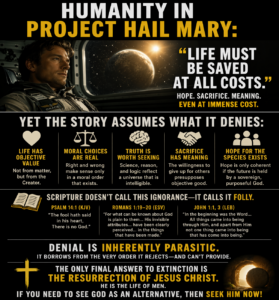
The scientific maxim “safety is irrelevant if the alternative is extinction,” which threads through the movie “Hail Mary Project,” can be restated in the register of a scientific good whose measure is saving as many lives as possible, even at the expense of the few. Even so, it cannot escape the prior question it presupposes. To speak of saving lives at all is to confess that life is good; that its loss is an evil; that people are not exchangeable quantities; and that some ordering of the world binds the investigator to pursue one motivation over the other (whether scientific, socially, politically, or even epistemologically).
None of these convictions is produced by the laboratory; they are the unpurchased furnishings and lived lives that the laboratory carries in before the first instrument is mathematically calibrated, including its experiences, libraries, history, and internal self-training. The scientist who works to rescue the perishing—whether from cosmic disaster, plague, famine, or the slow extinctions of neglect—acts according to a hierarchy of values that their instruments cannot measure and methods cannot generate. In brief, they act as creatures whose reason reflects a prior rationality, whose moral seriousness reflects a prior goodness or righteousness, and whose very impulse to preserve the breath of their neighbor reflects the One who first breathed breath into the dust calling forth the living soul.
It becomes proper to name God, at least within human reason, as a measured alternative. He is not an intrusion upon the scientific enterprise but the sufficient ground without which good dissolves into a preference of personal differentials.
Scripture itself measures God’s name:
God is not merely one being among many whose existence is assumed to fill a conceptual gap; rather, He is the One in whom we live, move, and have our existence (Acts 17:28, LEB), the One through whom, from whom, and to whom all things originate (Romans 11:36). He is not regarded as a hypothesis subject to revision based on new data; rather, He is presupposed as the foundational condition enabling hypothesis, inference, measurement, and the love of neighbor—who may be saved through these means—to be meaningful and worthy of pursuit despite the expenditure of time, the progress of humanity, the suffering of children, the plague of hatred and war. This is God’s mercy.
Science holds value, but only insofar as it is grounded in Good. To speak of extinction as the Ultimate Evil is, albeit subtly, to acknowledge that being is preferable to non-being. Recognizing this preference inherently relies on the doctrine that being itself is a gracious gift from the One whose name is I AM (Exodus 3:14, KJV).
The reflection of God in all things presupposes His existence. Creatures cannot evaluate goodness, value life, mourn loss, or calibrate ethical standards without relying on a moral order they did not establish and cannot revoke. Even the act of refusing to acknowledge God constitutes a form of reflection, as such refusal appeals to principles of honesty, coherence, and benevolence that have no foundation in a universe composed solely of matter and motion. “The fool hath said in his heart, There is no God” (Ps. 14:1, KJV), and Scripture does not regard this folly because of poor reasoning but because denial is inherently parasitic upon the very order that the denial itself cannot provide. Similarly, scientists who save lives exemplify a long-standing, often unconscious testament that the world is inherently such a place where lives are worth preserving—to be precise, a universe crafted and sustained by a Creator whose goodness is not merely an attribute but constitutes His very essence. Humanity wants the goodness it has lost; it continually struggles to attain it through the advancement and application of science.
Project Hail Mary argues for a good at a cost we cannot always see, and for hope of the species, which is often costly, born of frailty and nurtured through humility. All good science fiction addresses these issues. It reflects upon God absently; He is noted as an alternative to extinction. He really isn’t.
This is what the Scriptures declare, and they declare it not as one option among a shelf of metaphysical postures but as the native air of every faculty the creature possesses. “The heavens declare the glory of God; and the firmament sheweth His handywork” (Ps. 19:1, KJV). “For what can be known about God is plain to them, because God has shown it to them. For His invisible attributes, namely, His eternal power and Divine nature, have been clearly perceived, ever since the creation of the world, in the things that have been made” (Rom. 1:19–20, ESV). “In the beginning was the Word, and the Word was with God, and the Word was God. All things came into being through Him, and apart from Him not one thing came into being that has come into being” (John 1:1, 3, LEB). Thus the scientific good of saving lives, when pressed to the root, is not a neutral utility propped upon the void; it is a derivative mercy, a creaturely echo of the God who upholds all things by the Word of His power (Heb. 1:3) and in whom extinction finds its only final answer: in the resurrection of the dead by Jesus Christ, who is Himself the Life of men.
It amazes me how so many are willing to question God, or advance that they cannot know Him, when all around and within them, even their position within humanity, represents the evidence He is.
If you need to see God as an alternative, then seek Him now!